(…) It is ironic that on the basis of an elementary calculation and erroneous conclusion, Ising’s name has become among the most commonly mentioned in the theoretical physics literature. But history has had its revenge. Ising’s name, which is correctly pronounced “E-zing,” is almost universally mispronounced “I-zing.”
Barry Simon
We are organising a seminar on the exact solutions of the two-dimensional Ising model for the anniversary of Ernst Ising’s celebrated solution to the one dimensional Ising chain. Talks will be typically 2 hours long and will be announced on this page.
Talks
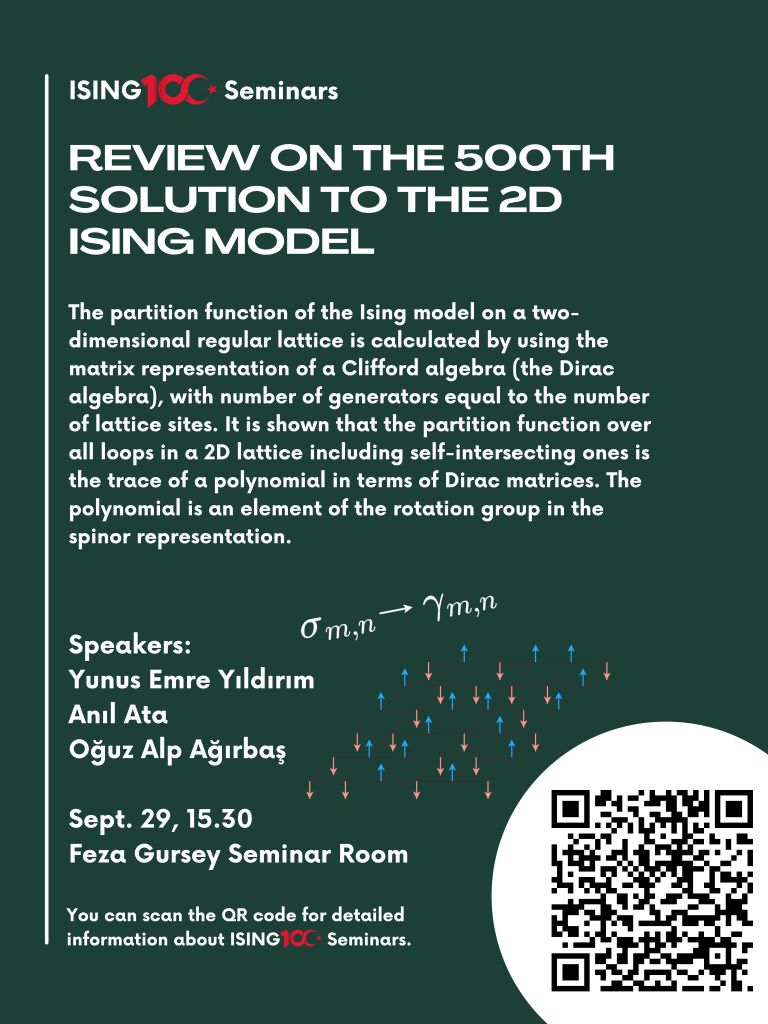
Review on the 500th solution to the 2D Ising Model, Date: 29/09/23
Speakers : Yunus Emre Yıldırım, Anıl Ata, Oğuz Alp Ağırbaş
Abstract
Review on the Combinatorial Solution of the Ising Model, Date: 29/09/23
Speakers : Eren Demirci
Abstract
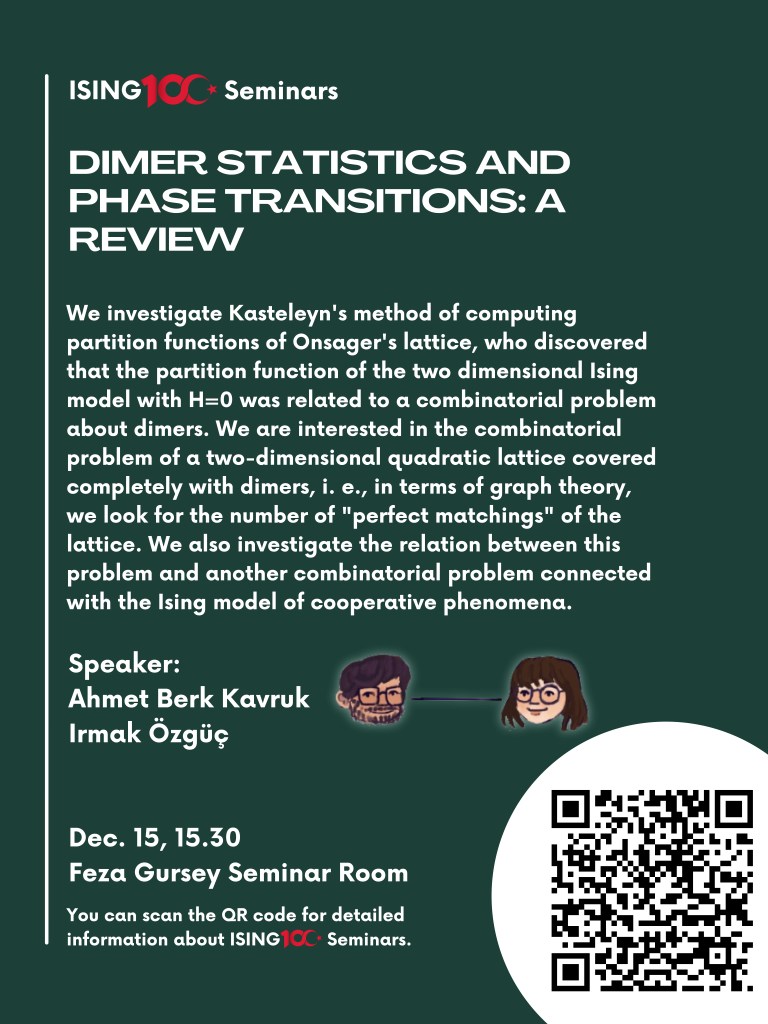
Dimer Statistics and Phase Transitions, Date: 15/12/23
Speakers : Ahmet Berk Kavruk, Irmak Özgüç
Abstract
We investigate Kasteleyn’s method of computing partition functions of Onsager’s lattice, who discovered that the partition function of the two-dimensional Ising model with H=0 was related to a combinatorial problem about dimers. We are interested in the combinatorial problem of a two-dimensional quadratic lattice covered completely with dimers, i.e., in terms of graph theory, we look for the number of ‘perfect matchings’ of the lattice. We also investigate the relation between this problem and another combinatorial problem connected with the Ising model of cooperative phenomena.
Fermionic Formulation of Ising Model, Date: 14/10/23
Speakers : Reyhan Yumuşak, Ali Mert Yetkin
Abstract
399th Solution of Ising Model, Date : 14/10/23
Speakers : Semih Kanber, Tuğba Hırlı
Abstract
Finding Partition Function for 2D Ising Model Using SO(2N) Algebra
Speakers : Ulaş Öztürk, Cansu Özdemir
Abstract
Recursive method in one dimensional Ising model
Speakers : Zehra Özcan
Abstract
The one-dimensional Ising model with only nearest neighbor interactions is one of the simplest models to solve exactly in statistical mechanics. It can be solved exactly by various methods, including the transfer matrix, generating function, and induction. However, when second or third-nearest-neighbor interactions are taken into account, the problem becomes significantly more complicated. In higher dimensions, this method is more useful than other methods for finding exact analytical solutions. We present a recursive method for solving nearest-neighbor interactions exactly. We’ll follow the paper “Recursive Method in One-Dimensional Ising Model” by E. Marchi and J. Vila.
Solving the one-dimensional Ising chain via mathematical induction
Speakers : Uveys Turhan

 Istanbul Integrability and Stringy Topics Initiative